
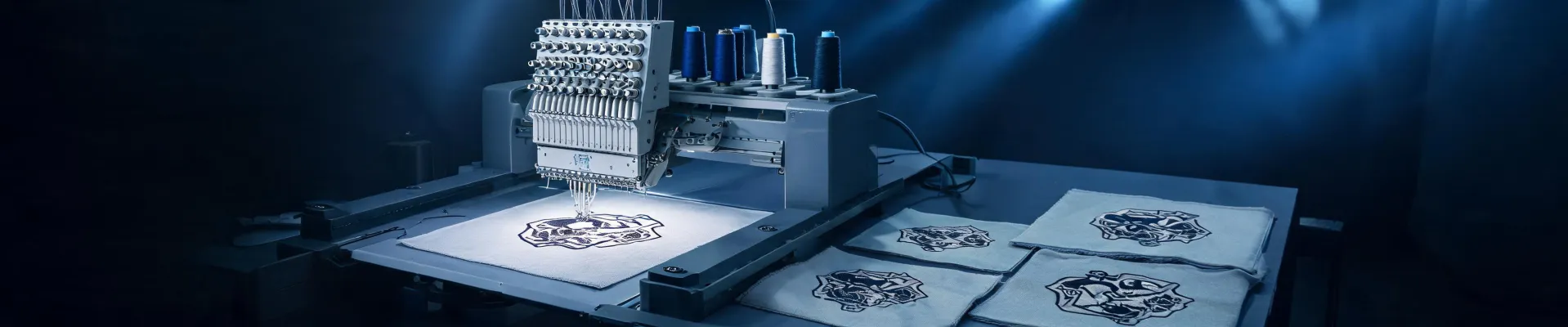
Melco vs HappyJapan: What I Check Before Buying a Commercial Embroidery Machine
2026-10-09 · Adrian Okafor
-
Dimension 1: Melco embroidery machine price vs HappyJapan price — and how much are Melco embroidery machines really?
-
Dimension 2: Software, hoops, and machine embroidery designs for denim jackets
-
Dimension 3: Mini embroidery machines and scaling without buying twice
-
How I'd choose between Melco and HappyJapan
If you're comparing a Melco embroidery machine against a HappyJapan embroidery machine, you're probably not asking which one is “better.” You're asking which one will survive your production schedule, your staff, and your denim jacket orders without turning every rush job into a repair ticket.
I'm a quality and brand compliance manager at a contract embroidery shop. I review every equipment and accessory decision before it hits production—roughly 30 purchases a year, from needles and backing to full multi-head machines. I've rejected about 20% of first-pass vendor quotes in 2024 because the specs didn't match the work we actually sell. So here's the comparison framework I use.
This isn't a spec-sheet dump. I'm comparing Melco and HappyJapan on three things that actually change your cost per stitch: price structure and total cost of ownership, software and hoop workflow for denim jackets, and scalability from mini/entry-level machines to multi-head production.
A machine's sticker price is only the first invoice. The second invoice is usually where the real number shows up. That's the pattern I've seen across 200+ accessory and equipment reviews.
Dimension 1: Melco embroidery machine price vs HappyJapan price — and how much are Melco embroidery machines really?
Let's start with the question everyone asks first: how much are Melco embroidery machines? And what does a HappyJapan embroidery machine cost in the same shop?
I can't give you one number, because Melco pricing depends on head count, needle count, hoop options, software bundle, installation, and dealer territory. A single-head 16-needle Melco and a 4-head 16-needle Melco are not in the same pricing universe.
Based on dealer quotes I reviewed in Q4 2024 and early 2025, commercial Melco embroidery machine pricing generally starts around $12,000–$18,000 for a well-equipped single-head commercial unit and climbs into the $25,000–$45,000+ range for multi-head production configurations. HappyJapan quotes I've seen over the same period often land lower on entry-level single-head machines, but the gap narrows—or flips—when you add the software, hoops, and training you'll actually need for commercial denim work.
That last point matters. A lower melco embroidery machine price or HappyJapan price isn't a win if you're buying twice. I've seen shops save $1,200 on a hoop package only to spend $2,800 on custom fixtures and downtime when the standard hoops couldn't handle thick denim seams. The cheap option wasn't cheap.
So when I compare price, I look at four lines:
- Machine and controller
- Embroidery software license and training
- Hoop/frame ecosystem for thick garments and denim jackets
- Parts, service, and downtime risk
My conclusion for this dimension: Melco often makes more sense when you need an integrated software-to-machine workflow and plan to scale into multi-head production. HappyJapan can be the sharper financial choice for a single-head shop that mainly runs flat goods and doesn't need a deep commercial software ecosystem. If your only metric is the lowest initial quote, neither brand is the whole story—and you should probably look at a used or entry-level machine only if your volume truly supports it.
Dimension 2: Software, hoops, and machine embroidery designs for denim jackets
Denim jackets are where hobby-grade assumptions go to die. The fabric is thick, the seams are bulky, and a design that stitches perfectly on a polo can pucker, shift, or break needles on a denim jacket.
If your target work includes machine embroidery designs for denim jackets, the machine brand is only half the decision. The other half is whether the software and hoop system let you handle placement, density, underlay, and seam avoidance without guesswork.
Melco's advantage here is the integrated ecosystem. Their software and hoops are designed to work together, and for shops doing repeatable commercial runs, that reduces the “will this frame fit?” conversation. If your denim jacket designs need large back placements, multiple hoop positions, or precise registration across a run, Melco's workflow is usually more production-friendly.
HappyJapan also has capable commercial software and hoop options, but the experience depends more on the dealer bundle. I've seen HappyJapan packages where the included software was fine for basic lettering and simple logos, but shops had to add third-party digitizing or upgrade hoops for thick denim. That's not a defect—it's a configuration issue. The problem is when you don't price it in.
Here's the thing: a lot of buyers compare machines by needle count and ignore the hoop list. For denim jackets, I care about magnetic vs. clamp systems, cap/garment frames, and whether the machine's sewing field matches the designs you actually sell. A 16-needle machine with the wrong hoop set is slower than a 10-needle machine with the right fixtures.
My conclusion for this dimension: If denim jackets are a core product line, Melco's integrated software and hoop ecosystem usually gives you fewer integration surprises. If denim is occasional and you already have a digitizer and hoop supplier you trust, HappyJapan can work—provided you verify the exact hoops and software modules in the quote. To be fair, both brands can do the work. The difference is how much you have to assemble yourself.
Dimension 3: Mini embroidery machines and scaling without buying twice
The search for embroidery machine mini often comes from a good place: you want to test the market, take small orders, or add personalization without a $20,000 commitment. But a mini machine and a commercial Melco or HappyJapan are solving different problems.
Mini embroidery machines are usually single-needle or few-needle units. They're good for samples, one-off names, and very small runs. They are not built for eight-hour production days, thick denim stacks, or the vibration that comes with commercial speeds. I've watched a shop try to bridge the gap with a mini machine during a busy season. It worked for two weeks. Then the timing drifted, and they lost a weekend redoing jackets.
So where do Melco and HappyJapan fit?
Melco is built around commercial production. Its multi-needle and multi-head options are meant to scale from a single-head starter commercial machine to multiple heads. If you're moving from “I think there's demand” to “I have purchase orders,” Melco's path is usually clearer because the software and accessory ecosystem scales with the machine.
HappyJapan also offers commercial single-head and multi-head machines. In my sample, HappyJapan tends to be strong for shops that want a straightforward single-head commercial machine with a lower entry price and don't need a multi-head roadmap right away. But if you plan to add heads in 18 months, check the software and training costs for that next step before you buy the first machine.
Here's my honest limitation: I've only worked with domestic dealers and North American support channels. If you're sourcing internationally, your service, parts, and training experience might differ significantly. I can't speak to how these machines perform under a different support model.
My conclusion for this dimension: Don't buy a mini machine expecting commercial output. If you need commercial production and denim work, buy a commercial single-head Melco or HappyJapan and grow into it. Between the two, Melco is probably the better fit if your growth plan includes multi-head expansion and software-integrated workflows. HappyJapan is likely the better fit if you want a lower-cost commercial single-head entry and your growth is steady but not head-count-driven.
How I'd choose between Melco and HappyJapan
It took me three years and about 150 vendor and equipment reviews to understand that the “best” embroidery machine is almost never the one with the lowest sticker price. It's the one that matches your production reality. Here's how I'd decide.
Choose Melco if:
- You run a commercial shop with repeatable orders and need software, hoops, and machine support from one ecosystem.
- Denim jackets, thick garments, or large back placements are a real part of your revenue.
- You plan to add heads or scale into multi-needle/multi-head production.
- You want fewer integration variables and are willing to pay for that certainty.
Choose HappyJapan if:
- You're buying your first commercial single-head machine and need a lower entry point.
- Your work is mostly flat goods, simple logos, and moderate runs.
- You already have a digitizer, hoop supplier, and training resource you trust.
- You don't need a multi-head roadmap in the next 12–18 months.
Look elsewhere—or wait—if:
- You need a true embroidery machine mini for samples only. Neither Melco nor HappyJapan is the cheap answer for that. Buy a mini machine for what it is, or outsource samples until volume justifies commercial equipment.
- Your denim jacket designs are experimental and low-volume. A commercial machine is a fixed cost. If you can't keep it stitching, it's a liability.
- You're choosing solely on how much are Melco embroidery machines or HappyJapan machines. Price matters, but total cost per finished jacket matters more.
One more thing: this pricing view was accurate as of Q4 2024 and early 2025. The commercial embroidery market changes fast, especially with dealer promotions and software bundles. Verify current quotes, hoop availability, and training terms before you sign.
My experience is based on about 40 commercial equipment evaluations and 200+ accessory/consumable reviews. If you're a hobbyist or micro-business, your experience might differ. But if you're buying for a production shop, use the three dimensions above—price structure, denim workflow, and scaling path—and you'll avoid the expensive mistake of buying the wrong machine twice.
Adrian Okafor
Adrian Okafor is a professional audio systems analyst specializing in loudspeakers, PA speakers, subwoofers, line arrays, stage monitors, power amplifiers, and audio mixers. He uses IEC 60268-5 measurement methods for applicable passive loudspeakers while comparing frequency response, sensitivity, maximum SPL, nominal impedance, dispersion, crossover behavior, amplifier headroom, limiter settings, and rigging loads. His system guides help sound designers, rental companies, venues, and installers match acoustic coverage, audience capacity, deployment geometry, power distribution, monitoring needs, and safe operating margins.
Leave a Reply
Recent Posts
What an Undercover Compliance Check Taught Me About Age-Verification Vending Machines
I wasted $12,400 on vending equipment before I understood why ID verification is the only spec that actually matters. Here's the mistake, the fine, and the checklist that replaced it.
Melco Embroidery Machine Reviews Won't Tell You This—But Your Hooping Will
After three commercial embroidery machine purchases in five years, I've learned that reviews and price sheets only cover half the story. Here's what actually determines ROI in a real shop.
Choosing the Right Commercial Embroidery Setup: Three Scenarios (and the Mistakes I Made in Each)
A decision-framework guide for commercial embroidery equipment buyers, organized by three shop scenarios — with real cost mistakes, equipment comparisons, and a self-assessment checklist. Covers Melco EMT16X pricing, hoops, entry-level options, and more.
Melco vs HappyJapan: What I Check Before Buying a Commercial Embroidery Machine
A quality compliance manager compares Melco and HappyJapan commercial embroidery machines on price, software, hoops, mini options, and denim jacket workflows. Includes TCO red flags and scenario-based advice.
Sourcing a Melco Embroidery Machine for Sale Under Deadline Pressure: 9 Steps I Run
A rush-sourcing checklist for commercial multi-needle embroidery machines — from converting your deadline into hours to testing with your own file before you pay.
How Much Does a Melco Embroidery Machine Cost? A $12,000 Mistake I Made So You Don't Have To
A small embroidery shop owner shares how a Melco purchase quote turned into a $12,000 lesson about total cost, sewing machine output, small orders, and the questions to ask before buying.
Why Cheap Thread and Worn Hoops Cost More Than a Used Melco Embroidery Machine
A procurement manager's argument for why rework, client perception, and TCO make cheap embroidery inputs and undocumented used machines the most expensive choices in a commercial shop.
Commercial Embroidery Machine Checklist: Melco, Hoops, Software, and When a PE570 or Singer HD500 Makes More Sense
A quality manager's 7-step checklist for specifying a commercial embroidery sew machine, from hoops for Melco embroidery machine to Melco EMT16X price checks and honest limitations.
Your Melco Emergency Is Probably an Inspection Problem
Most rush embroidery failures start before the machine runs. A commercial embroidery specialist explains why prevention beats cure for Melco shops, Bravo owners, and London deadlines.
Why I Won't Buy a Home Embroidery Machine for Commercial Production (And When You Should)
A procurement manager's take on Melco Bravo, Melco embroidery software, and why hobby machines like SE2000 or Usha Janome Memory Craft 550E rarely belong in a commercial shop.